For trustees of community centres across the UK, managing bookings is often the “necessary evil” of keeping the lights on. It generates the revenue needed to serve the community, yet the process itself is frequently manual, messy, and time-consuming.
Between deciphering vague emails (“Can I book the big room next Tuesday?”), chasing payments, and manually updating spreadsheets, valuable volunteer hours are lost.
But what if your booking form could think for itself?
We are entering an era where AI-assisted tools are no longer just for tech giants. They are becoming accessible plugins that can be dropped into your existing WordPress website, transforming how you manage your hall hires. Here is why trustees should care, and how the “Regal Venue Booking” concept works in practice.
The Problem with Traditional Booking Forms
Most community centre websites have a standard contact form. It usually asks for:
- Name
- Message
The problem lies in the “Message” box. A potential hirer writes: “Hi, I’d like to book a party for 55 people next Friday evening.”
This single sentence triggers a game of administrative ping-pong:
- The Admin has to check the calendar.
- The Admin has to check the fire safety capacity (is 55 people too many for the small room?).
- The Admin has to email back to ask for the specific date (which “next Friday”?).
- The Admin has to calculate the cost manually.
This friction loses bookings. In the age of instant gratification, people want immediate answers.
Enter the AI-Assisted Plugin
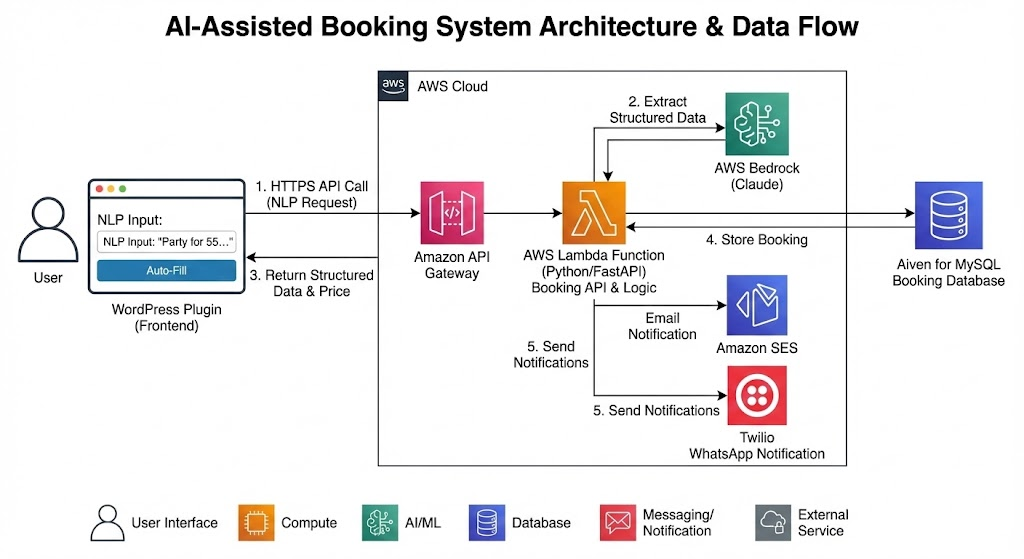
Imagine a plugin on your WordPress site that replaces that static form with an intelligent assistant. Based on the “Regal Venue Booking” system, here is how the workflow changes:
1. Intelligent “Auto-Fill”
Instead of forcing users to fill out ten different fields manually, the AI allows them to type naturally.
- User Types: “I need the main hall for a wedding reception for 120 guests on August 24th from 2pm to midnight.”
- The AI Actions:
- It detects “120 guests” and instantly selects the Main Hall (knowing the smaller rooms can’t hold that many).
- It identifies the date and converts it to a structured format.
- It locks in the start and end times.
2. Smart Room Logic
One of the biggest headaches for trustees is capacity management. An AI plugin can be programmed with your specific “Logic Ladder”:
- 1–12 people? → Auto-select the “Aston Room” (Small meeting room).
- 13–25 people? → Auto-select the “Henley Room”.
- 30+ people? → Auto-select the “Main Hall”.
This prevents small groups from booking your largest revenue-generating space unnecessarily, maximizing your centre’s income potential without a human needing to intervene.
3. Instant, Accurate Pricing
Calculation errors are common when relying on volunteers to remember hourly rates, deposit rules, and kitchen fees. The system automates this:
- Hourly Rate: Automatically multiplied by the duration.
- Late Fees: If the booking goes past 9 PM, the system can automatically add your standard £50 late fee.
- Commercial vs. Charity: Ticking a “Commercial Use” box can instantly double the deposit required.
4. Automated Communication
Once the user hits “Submit,” the system doesn’t just send an email; it broadcasts the details instantly:
- To the Hirer: An immediate confirmation email with the final price.
- To the Admin: A WhatsApp notification or email with a clean summary, meaning you can approve bookings from your phone in seconds.
Why This Matters for Trustees
Reduce Volunteer Burnout
The most precious resource a charity has is not money, but volunteer energy. By automating the “boring bits”—data entry, pricing, and calendar checking—you free your team to focus on fundraising, maintenance, and community engagement.
Professionalism and Revenue
A slick, instant booking experience makes your community centre look professional. It gives hirers confidence that their event is in safe hands, leading to more repeat bookings and better reviews.
Low Cost, High Impact
You do not need a £10,000 custom software suite. The solution described here is a WordPress Plugin. It lives on your existing website. The AI “brain” (using tools like AWS Bedrock or OpenAI) costs fractions of a penny per booking request.
The Technical Reality Check
Is it difficult to set up? Not necessarily.
- The Platform: It runs on WordPress, the platform most community centres already use.
- The Requirements: You need a simple hosting account and a small budget for the AI API (often less than £5/month for low usage).
- The Data: Your data stays under your control, stored in your own database (or a secure cloud database like MySQL), ensuring you remain GDPR compliant.
Conclusion
For decades, community centres have run on goodwill and paper diaries. As we move into 2025, trustees have the opportunity to adopt tools that respect their volunteers’ time. An AI-assisted booking form isn’t about removing the human touch—it’s about removing the robotic tasks so the humans can do what they do best: building a community.
Ready to modernize your hall hire? Speak to your web volunteer about integrating AI-assisted forms today.