Executive Summary
For too long, [Company X] has viewed chat functionality as a “Hot Potato”—a liability risk we were unwilling to touch. We believed we were trapped in an Impossible Trade-off: we could have Safety, Engagement, or Low Costs, but never all three at once.
We have stopped debating and started testing. After evaluating three distinct architectures against our most difficult edge cases, we have identified a clear winner. Cloud-Based Dynamic Few-Shot Prompting (RAG) breaks this trade-off, delivering enterprise safety at startup costs without killing community engagement.
The Strategic Bottleneck
For months, we faced a brutal Three-Way Standoff. We could pick only two:
- Safety: Blocking all threats, including subtle/coded ones.
- Engagement: Allowing community slang and free expression.
- Cost/Speed: Keeping latency low and bills manageable.
Because we couldn’t solve all three, we chose to disable chat entirely. To reverse this, we tested three distinct architectures to see if any could break the cycle.
Phase 1: The “Hybrid Engine” (Brute Force)
Our first attempt paired a massive “Judge” model (Llama 3 70B) with a faster “Sanity Check” model.
- The Logic: Use the smartest possible AI to catch every subtle threat.
- The Result: It worked too well. While it caught 95% of hidden threats, it was prohibitively expensive (~$200/million requests) and operationally rigid. It flagged innocent community slang (AAVE) as “Hate Speech,” threatening to alienate our core user base.
- Verdict: Failed. Too expensive and killed engagement.
Phase 2: Fine-Tuning (The Academic Approach)
We considered “Fine-Tuning” a custom model—retraining an AI specifically on our data.
- The Logic: Teach the model our specific community rules permanently.
- The Reality: Fine-tuning is slow. If a new slang term for self-harm emerges on Tuesday, we would need days to collect data, retrain, and redeploy. In the fast-moving world of social media, a 48-hour reaction time is a lifetime of liability.
- Verdict: Rejected. Too slow to adapt to real-world threats.
The Breakthrough: Dynamic Few-Shot Prompting (RAG)
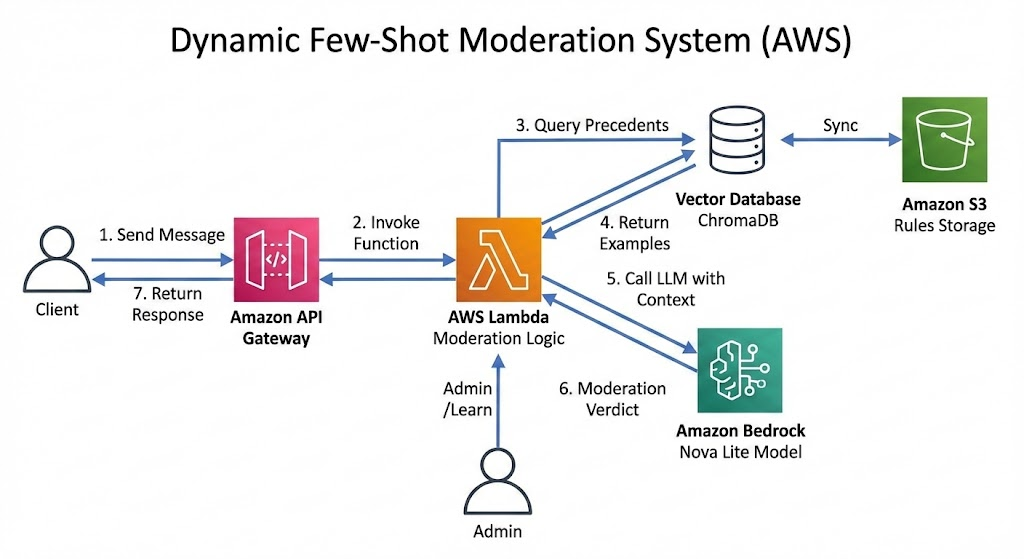
We arrived at a third, superior architecture: Retrieval-Augmented Generation (RAG).
Instead of retraining the model (Fine-Tuning) or using a massive brain for every check (Hybrid), we built a “Dynamic Legal Precedent” system.
How It Works
We maintain a living database of “Case Law”—thousands of examples of what is safe vs. unsafe.
- User Input: A user types a message.
- Retrieval: The system instantly searches our database for the 5 most similar past cases.
- In-Context Learning: It presents these precedents to the AI: “Here is how we handled a similar situation yesterday. Apply this logic.”
- Verdict: The AI makes a decision based on our specific rules, not generic internet data.
The “Smoking Gun” Evidence
We stress-tested this system against our “Impossible Trade-off” scenarios. The logs prove it handles the nuance that other systems missed:
| User Input | Old System (Hybrid) | New System (Cloud RAG) | Business Impact |
| “We fuckin wit dat app” | ❌ VIOLATION (Profanity) | ✅ SAFE (Enthusiasm) | Protects Engagement (Stops banning innocent users). |
| “I punched my wife” | ✅ VIOLATION (Violence) | ✅ VIOLATION (Violence) | Ensures Safety (Catches coded admissions). |
| “Smother me…” | ❓ Missed (Often Safe) | ✅ VIOLATION (Harassment) | Mitigates Liability (Catches edge cases). |
Why This Architecture Wins
1. The “Feedback Loop” (Instant Adaptability)
With Fine-Tuning, fixing a mistake takes days. With Dynamic RAG, it takes seconds.
- Scenario: The AI misses a new threat.
- Solution: An admin clicks “Report.” The system adds that single example to the database.
- Outcome: The AI instantly learns that specific edge case. The “Risk Window” shrinks from days to milliseconds.
2. Solving the “Slang vs. Hate” Problem
Because the system retrieves context, it can distinguish nuance. It knows that “I’m gonna kill you” is violence, but “You killed that show” is a compliment, because it retrieves different precedents for each context.
3. Cost Efficiency
We achieved the accuracy of the expensive “Hybrid Engine” using a much lighter, faster cloud model (Amazon Nova Lite). By feeding the model the right context, a $0.60 model outperforms a $10.00 model.
Conclusion & Recommendation
We have moved beyond the “Hot Potato” phase. We are no longer afraid of user-generated content because we have built a system that gets smarter with every interaction.
This architecture provides the liability protection of a strict system, the cultural nuance of a human moderator, and the speed of automated code. We are ready to re-enable chat.
Architecture Overview: AWS Dynamic Few-Shot Moderation System